-
-
$
In Stock
0 Review(s)

Price :
$490
$2095
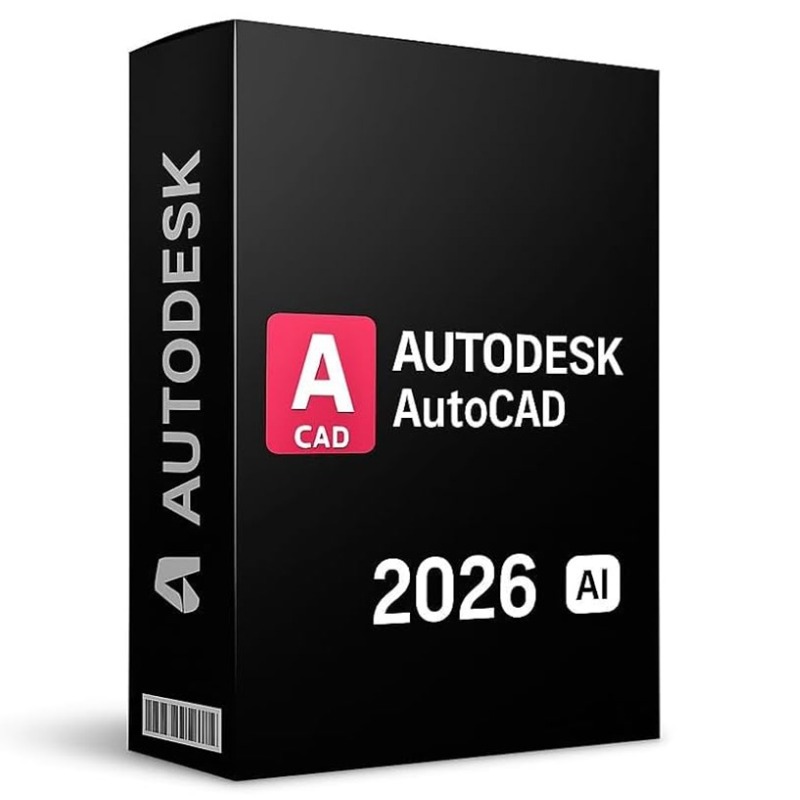
AutoCAD 2026 brings a range of new features and enhancements focused on speed, AI-powered automation, and improved collaboration. Here's a breakdown of the key highlights:
1. Enhanced Performance:
Faster File Open and Startup: AutoCAD 2026 is designed to be the fastest release yet, with significant improvements in file opening (up to 11x faster on average) and application startup times (up to 4x faster).
Graphics System Fabric (GSF): Utilizes modern GPUs and multi-core CPUs for improved graphics performance, especially in large 3D drawings.
Asynchronous Raster Image Loading: Raster images now load in the background when opening drawings, improving overall performance.
2. AI-Powered Automation and Smart Features:
Smart Blocks: Placement: Automatically suggests and places blocks in your drawing based on your previous placements, reducing clicks and saving time.
Smart Blocks: Replacement: Quickly finds and replaces existing blocks with machine learning-based suggestions, recently used blocks, or manual selection.
Smart Blocks: Search and Convert: Identifies identical blocks and, now, text variations within your drawing to convert them into block attributes, streamlining repetitive tasks like standardizing room numbers or labels.
Smart Blocks: Detect and Convert (Tech Preview): Uses Autodesk AI to automatically recognize objects (like doors, toilets, lighting symbols) and text variants that can be converted into blocks, improving drawing cleanup and efficiency.
Autodesk Assistant: A conversational AI for quick access to helpful support and solutions related to AutoCAD features and design challenges, providing summarized responses and learning resources.
My Insights: Provides personalized tips, features, and macros based on your AutoCAD usage to help you complete projects faster.
3. Improved Collaboration and Connectivity:
Connected Support Files: CAD managers can define a single set of project-aware support files (like fonts, plot styles, templates, Lisp files) for an Autodesk Docs project, ensuring all team members work with the correct settings without individual configuration.
Markup Import and Markup Assist: Enhanced capabilities for importing markups from paper or PDFs, including improved recognition of text, strikethroughs, and boundary markups. It now also supports importing markups directly from Autodesk Docs.
Push to Autodesk Docs: Publish CAD drawing sheets as PDFs directly from AutoCAD to Autodesk Docs.
Activity Insights: Provides detailed multi-user event logs with version history, tracking over 35 activity types, including object-based changes, total session time, and file size changes. The new "What's Changed" insight helps users quickly see edits made between sessions.
Multi-User Markup for AutoCAD on the Web (Early Access): Streamlines collaboration on Autodesk Docs projects by allowing multiple users to markup a single DWG drawing simultaneously without locking the file.
ArcGIS® Basemaps: Ground your site plans with real-world geographical information using high-resolution satellite and aerial imagery, OpenStreetMaps, Streets, and monochrome map styles from ArcGIS.
4. Enhanced Design Tools and Capabilities:
AutoLISP: Continue to build and run AutoLISP routines to streamline workflows and enforce CAD standards through automation.
Hatch Command Updates: Adds texture to drawings through patterns, fills, and paths without requiring pre-defined shapes or enclosed boundaries.
Added Layer Option to CENTERLINE and CENTERMARK: You can now specify a default layer for centerlines and center marks using the new CENTERLAYER system variable, similar to how layers are set for text and dimensions.
Count Feature Enhancements: Automate the counting of block or object instances within a selected area or entire drawing, with improved navigation, filtering, and the ability to create fields and tables for display.
AutoCAD Foundations: A new learning series designed to guide new users through basic functionalities, including drawing creation, object manipulation, annotation, and plotting.
GDI Plot Enhancement: Improved compatibility with Windows system printers, handling custom configuration settings more effectively.
GPU Text Enhancement: Improved selection effect and display quality of GPU text, with optimization for Chinese, Japanese, Korean, Arabic, and Hebrew languages.
FASTSHADEDMODE Updates: Supports two new visual styles: Hidden and Conceptual, for improved navigation performance in large 3D models.
Operating System: 64-bit Microsoft® Windows® 11 or Windows 10 (version 1809 or above).
Processor:
Basic: 2.5–2.9 GHz processor with 8 logical cores (base).
Note: ARM processors are not supported.
Memory (RAM): 8 GB
Display Resolution:
Conventional Displays: 1920 x 1080 with True Color
High Resolution & 4K Displays: Resolutions up to 3840 x 2160 (with a capable display card)
Display Card:
Basic: 2 GB GPU with 29 GB/s Bandwidth and DirectX 11 compliant.
DirectX 12 with Feature Level 12_0 is required for "Fast" visual styles.
Disk Space: 10.0 GB (SSD suggested)
Pointing Device: MS-Mouse compliant
.NET Framework: .NET 8
No Return/Refund.
No Review Found.







 Corel Software
 Nuance Software

.png)



Login To Comment